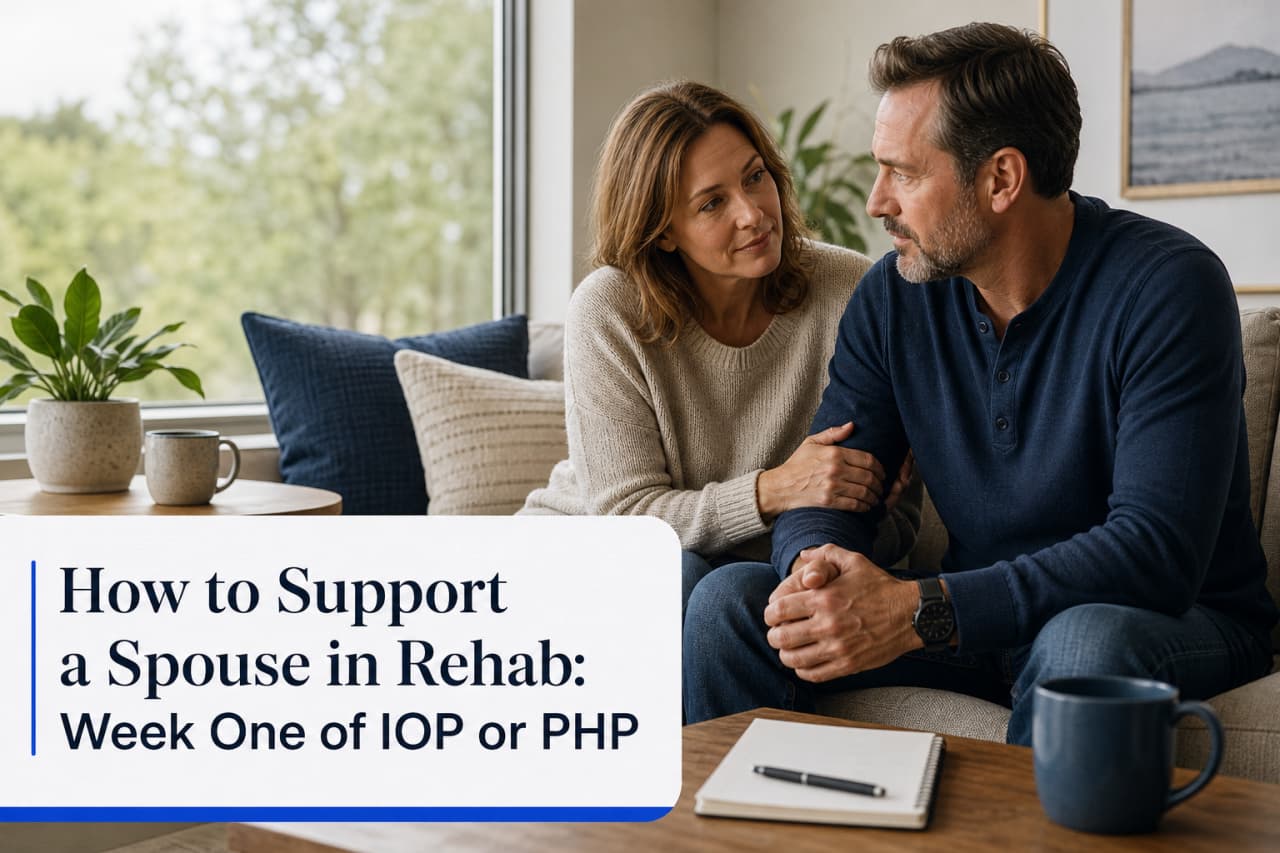
To support a spouse in rehab during the first week of IOP or PHP, protect their treatment hours, keep alcohol and drugs out of the house, and take over a few logistics so they can focus on showing up. Stay calm and curious, and skip the interrogation about what happened in sessions. You don't need to fix anything this week. You just need to keep home steady.
If your spouse is in danger or you're worried about suicide or overdose, call or text 988, or call 911 in an emergency.
What changes at home when you support a spouse in rehab during week one
Your household schedule will bend around treatment, and the first few days usually feel lopsided. In PHP, your spouse is in structured treatment for most of the day and comes home each evening. In IOP, sessions run several days a week, so some days look almost normal and others don't. Evening IOP typically meets 3 to 5 times a week for about 3 hours between 5:00 and 8:00 PM, and the exact schedule gets set at the intake assessment. Ask your spouse for the written schedule early so you can plan around it.
The biggest shift is who handles what. Your spouse may be tired, emotional, or quiet after sessions, because group and individual therapy take real effort. Expect to pick up a few extra tasks, such as school pickups, dinner, or rides if driving is a problem. Decide together which ones you'll cover so nobody is guessing.
Evenings change too. Treatment hours come first, so social plans, family visits, and late-night errands may need to move. If your spouse has homework, a safety plan, or a group to attend, give them quiet time to do it.
Your home also needs a quick reset. Remove alcohol and any substances or paraphernalia, and tell guests the house is alcohol-free for now. If your spouse takes medication as part of treatment, a licensed prescriber manages it, so ask what support looks like instead of keeping track of doses yourself.
You may feel relief, fear, anger, or all three in the same afternoon. That's normal, and it doesn't mean you're handling the week badly. If your spouse is in dual diagnosis treatment, which addresses addiction and a co-occurring mental health condition together, moods can also swing in ways that aren't about you. You can read more about how that care works on our dual diagnosis treatment page.
Practical ways to help without taking over
Start by asking your spouse one question: "What would make this week easier for you?" Then do what they say, even if it's smaller than you expected. Most people in early treatment want help with specific things, like a ride, a quiet hour, or a meal ready when they walk in, and they don't want a spouse who manages their recovery.
Handle the logistics that belong to you. That means childcare, groceries, bills, and calls to your employer or theirs if they've asked you to make them. Keep a shared calendar of treatment times so you aren't texting during a session to ask where the car keys are.
Keep your questions open and low-pressure. "How was today?" works better than "What did they say about me?" Your spouse decides how much to share, and some evenings the answer will be "fine, I'm tired." Accept that and move on.
Some things stay with your spouse, even when it's tempting to step in:
- Calling the care team to ask how they're "really doing"
- Checking their phone, bag, or car for signs of use
- Deciding which sessions, meetings, or goals matter most
- Explaining their treatment to friends, relatives, or their employer
If you're unsure where the line is, ask yourself whether the task keeps the household running or whether it controls their recovery. The first is your job this week, and the second belongs to your spouse and their clinical team.
Finally, say one specific, honest thing that's within your control, such as "I'm keeping the house alcohol-free, and I'm glad you're going." It tells your spouse where you stand without asking them to promise anything in return.
What to avoid saying in the first week
Certain phrases land as accusation even when you mean them as concern, and early treatment is when your spouse is most likely to hear them that way. "Why can't you just stop?" treats addiction as a choice you could talk them out of. A person with a substance use disorder usually already feels that shame, and hearing it at home can make them less willing to tell you anything.
Skip the ultimatums, too. "If you relapse, I'm leaving" may feel like a firm boundary, but said in week one it works as a threat, and it puts the weight of your marriage on a single bad day. If you need to set limits, do it calmly and later, once you've had time to think about what you can actually follow through on. Our post on setting boundaries without guilt walks through how to do that.
Avoid predictions and scorekeeping as well. "I'll believe it when I see it" and "Remember what you did at the party?" pull your spouse back into the past when they're trying to get through today. Grief and anger about what happened are real, and they belong in your own support space or with a counselor, not in the car ride home from group.
Try a few swaps that keep the same honesty with less heat:
- Instead of "Did you talk about me in there?" say "I'm here if you want to tell me anything."
- Instead of "Are you sure you're okay?" say "Do you want company or quiet tonight?"
- Instead of "You'd better not mess this up, " say "I'm glad you're going today."
Finally, don't compare your spouse to anyone else's recovery. Every treatment plan is built around the person, and a friend's story about how fast someone improved tells you nothing about your spouse's week.
Why the care team may not share details with you
Federal confidentiality rules for substance use disorder treatment records are strict, and a spouse isn't automatically on the list of people who can hear about your partner's care. The rule is 42 CFR Part 2, and SAMHSA explains it in plain terms: a treatment program generally needs the patient's written consent before it shares identifying information with someone outside the treatment team. Being married doesn't change that.
In practice, you may call and hear that the team can't confirm whether your spouse is a client, let alone discuss progress. That isn't a judgment about you. The team would say the same to anyone who called without a signed release.
Your spouse can sign a consent form that names you and says what may be shared, such as attendance, schedule changes, or topics for a family session. They can also limit it, change it later, or decline. Ask them, once and without pressure, whether they'd be willing to sign one. If they say no this week, let it rest. Many people feel more ready after the first few days of treatment.
Here's what you can still do without a release:
Share concerns or safety information with the team. They can listen even when they can't respond.
Ask general questions about how the program works, how family involvement is handled, and what the admissions process looks like.
Ask your spouse to bring you the schedule and any family session details they're comfortable passing along.
If you're also sorting out insurance, the insurance verification process is separate from clinical information, so it's a good place to get logistical questions answered.
How family therapy invitations work
Most programs wait to invite a spouse until the person in treatment has settled in and agreed to it, so don't be surprised if nothing arrives in week one. Family involvement is one of New Hope's stated values, and it happens through family therapy and support groups. Even so, the invitation usually starts with your spouse's consent, which is why the release conversation matters.
When a session is planned, the care team typically reaches out to you directly or asks your spouse to pass along the details. Ask what the session is for before you go. Early family sessions often focus on understanding the treatment plan, hearing how addiction has affected the household, and agreeing on ways to support recovery at home. They aren't a place to be graded or blamed, and a licensed clinician guides the conversation.
You can prepare without rehearsing a speech. Think of two or three specific things you'd like your spouse to know, such as how the house has felt or what kind of help you can realistically offer. Also write down questions about the program itself, because those you can ask even when clinical details stay private.
If you're not invited this week, you haven't done anything wrong. Timing is set by your spouse's readiness and the clinical team's judgment, and the schedule varies by person. You can tell your spouse, once, "I'd be glad to join a family session whenever you think it would help, " and then leave the decision with them.
For a closer look at what these sessions involve, our post on family therapy in addiction recovery covers what to expect and how to take part.
Where you can find support of your own
Al-Anon and Nar-Anon are free peer groups for the families and friends of people with addiction, and you can attend a meeting this week without your spouse knowing or agreeing. Al-Anon is built around a loved one's drinking, and Nar-Anon around drug use. Most areas, including Knoxville, have in-person and online meetings, and you can sit in the back and listen the first time. SMART Recovery Family and Friends is another option if you'd rather have a skills-based group that doesn't use a 12-step format.
Try two or three different meetings before you decide, because the tone changes a lot from one room to the next. Some groups lean on faith and tradition, and others stay practical. You're looking for a place where you can say the angry, scared things you've been holding back from your spouse.
A licensed therapist of your own is worth considering too, especially if you're having trouble sleeping, eating, or concentrating. Your spouse's clinical team treats your spouse, so your counseling should be separate. That keeps your conversations private and gives you somewhere to work through resentment before it ends up in the car ride home.
Small routines help more than big plans this week. Keep one regular thing that has nothing to do with treatment, such as a walk, a meal with a friend, or an hour at the gym.
If you have questions about the program itself, or you'd like to check what your plan covers, you can verify your insurance or speak with admissions at New Hope. The call is confidential, and you can reach the team at 866-806-1027.